CASE STUDY: THE EVOLUTION OF EXCELLENCE
Case Study: The Evolution of Excellence From 1980s South Africa to the EEM Method™
1. The South African Legacy: "The Hard Standard"
In the 70s and 80s, South African training was built on Reliability under Pressure. Because dogs were working in extreme "Civil" environments—border patrols, high-risk security, and urban tracking—there was zero room for error.
The Strength: South Africa mastered Environmental Resilience. Dogs were trained to ignore gunshots, chaos, and heat. They were "hard" dogs that wouldn't back down.
The Best in the World? Yes. In terms of producing a dog that could transition from a sport field to a real-world tactical situation, South African bloodlines and training methods were legendary. Many European trainers actually looked to SA for "tougher" genetics.
2. The Old Way vs. The EEM Way
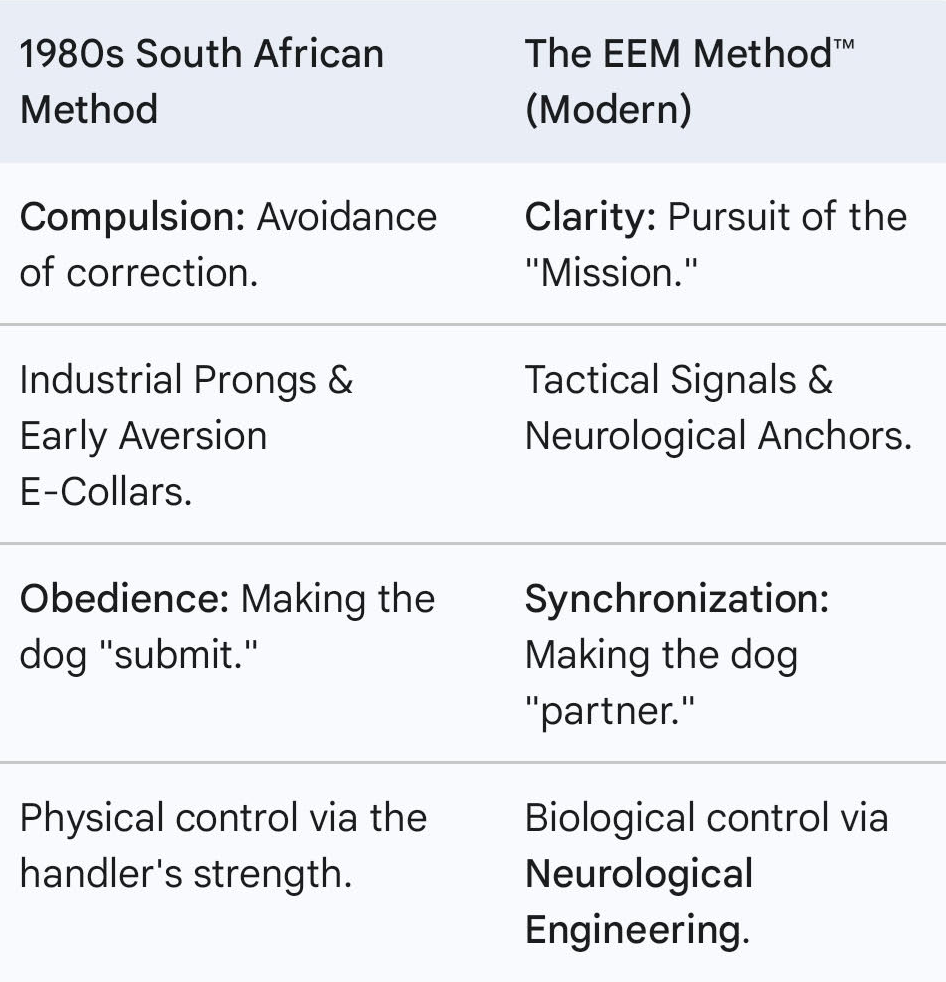
3. How We Have Evolved (The Case Study)
In the 80s, if a dog was "tense at the end of the lead" or "losing its head," the solution was a heavy physical correction to suppress the behavior. It worked, but it created a dog that was often "suppressed" or working out of fear.
The EEM Shift:
We keep the discipline and the high standards of the South African era, but we change the mechanism.
Instead of Suppression, we use Channeling: We don't crush the drive; we aim it (like the Bikejoring example).
Instead of Fear, we use The Social Bubble: We want the dog to look at the handler not because they have to, but because the handler is the only "Signal" that matters in a world of "Static."
4. Why This Matters Today
Modern dogs (especially those in suburban UK) are more sensitive than the 1980s SA farm-bred GSDs. If you use 80s "Hard" methods on a modern Malinois or Rottweiler without the EEM Clarity, you risk "breaking" the dog.
The EEM Method™ is the "Special Forces" version of 80s training: It is just as disciplined and just as effective, but it is much smarter.
"Built on the heritage of South African tactical excellence.
Refined by the science of K9 Engineering.
This is the EEM Method™."